
Do stainless steel quarter turn locks resist corrosion?
The material composition is the core of anti-corrosion. Industrial-grade stainless steel quarter turnlocks generally use 304 or 316 grade alloys. The key difference lies in the molybdenum content: The molybdenum content of 304 stainless steel is 0.5%, while that of the 316L model is increased to 2.1%, raising its Breakdown Potential in a 3.5% sodium chloride solution from 0.25V to 0.45V. The actual salt spray test data is more convincing: According to the ASTM B117 standard, the proportion of surface rusted area of the 304 stainless steel lock body in a 500-hour continuous salt spray environment reaches 12%, while that of the 316L type is only 2.3%. The 2019 mechanical maintenance report of the Port of Rotterdam confirmed that after replacing the 316L material quarter turn locks, the average annual replacement rate of panel locks dropped from 34% to 7%, and the spare parts cost was saved by 180,000 euros.
Extreme environment verification requires professional certification. In the field of Marine engineering, it is required to meet the ISO 9227 standard Level 6 protection. This means that in a simulated Marine atmosphere containing 50 milligrams of salt particles per cubic meter, the corrosion rate of 316 stainless steel within a 500-hour test period must be ≤0.01 millimeters per year. The standards for nuclear power facilities are more stringent: The French AREVA specification requires that the locks used in nuclear island equipment be immersed in boric acid solution (with a concentration of 23,000 PPM and a temperature of 80℃) for 300 hours, and the metal loss rate must be controlled to be less than 0.25mg/cm². The investigation report of the accident on the Brazilian oil platform shows that the control box with non-standard 304 locks failed after only 14 months of service in the high-salt environment at the equator, while the 316L locks that met the NORSOK M-650 certification maintained a service cycle of 62 months.
The tolerance capacity of industrial media determines the application boundary. In the chemical industry scenario, the 316L quarter lock is placed in a 40% sulfuric acid environment (60℃), and the annual corrosion rate remains at 0.12 millimeters. In the acetic acid environment, its mass loss rate is only 1/8 of that of model 304 (0.07g/m²·h). The comparative experiment of the citric acid production line of BASF in Germany shows that when the ambient PH value is as low as 2.5, the torque of the 304 lock body spring group decreases by 19% after 800 operations, while the torque deviation of the ultra-purified nitrogenous 316LMN (1.4435) model is ≤3% after 5000 cycles. Especially in chloride ion exposure scenarios - such as aeration tanks in wastewater treatment plants (Cl- concentration 8000ppm), the intergranular corrosion depth of high-quality 316L locks is controlled within 7 microns, which is far below the safety threshold of 20 microns.
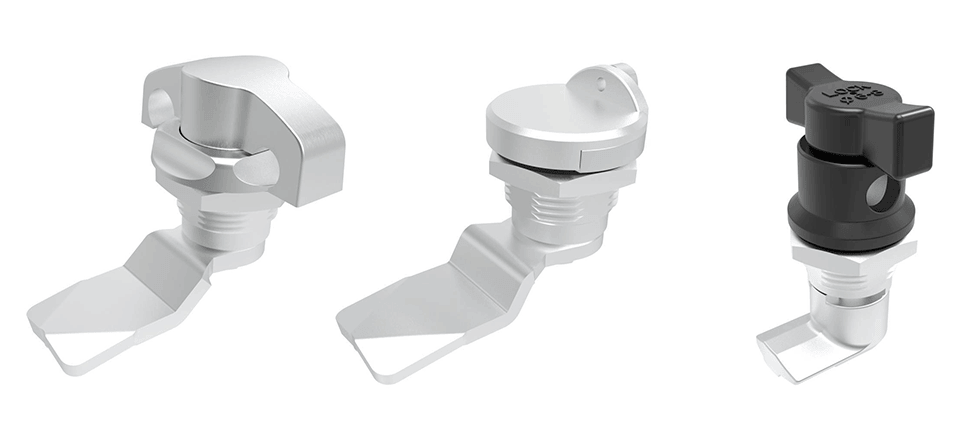 Surface treatment technology can enhance the protective effect. The physical vapor deposition (PVD) coating increases the surface hardness to HV1200, reducing the wear and corrosion co-loss rate of the 316 stainless steel substrate by 73%. Electrochemical passivation treatment extends the salt spray test tolerance time from 500 hours to 2000 hours by forming a 2.9-nanometers thick chromium oxide film layer in nitric acid solution (20% concentration, temperature 49℃). The maintenance and repair case of the Marine refrigeration unit has confirmed the effect: The traditional stainless steel lock developed stress corrosion cracks after 9 months under alternating cold and hot conditions, while the quarter-turn lock treated by ion nitriding (with a surface nitrogen penetration concentration of 18%) maintained no failure for 27 months.
The long-lasting sealing design compensates for the structural weaknesses. The rotary shaft seal is made of fluororubber (FKM) material, maintaining a sealing performance of 800,000 rotates in a hot oil environment at 150℃. Its aging life is five times longer than that of ordinary nitrile rubber. The data of the Shinkansen track equipment in Japan is more representative: The undercarriage inspection panel equipped with a fully sealed 316 stainless steel quarter-lock was disassembled and inspected after 120,000 kilometers of operation, showing that the salt deposition of the internal components was only 0.15mg/cm³ (8.7mg/cm³ in the open structure). The research report of the International Society of Corrosion Engineers (NACE) indicates that the properly designed maintenance intervals for stainless steel quarter turn locks used in Marine engineering can reach three times that of conventional products, and the maintenance labor cost can be reduced by 57%.
Surface treatment technology can enhance the protective effect. The physical vapor deposition (PVD) coating increases the surface hardness to HV1200, reducing the wear and corrosion co-loss rate of the 316 stainless steel substrate by 73%. Electrochemical passivation treatment extends the salt spray test tolerance time from 500 hours to 2000 hours by forming a 2.9-nanometers thick chromium oxide film layer in nitric acid solution (20% concentration, temperature 49℃). The maintenance and repair case of the Marine refrigeration unit has confirmed the effect: The traditional stainless steel lock developed stress corrosion cracks after 9 months under alternating cold and hot conditions, while the quarter-turn lock treated by ion nitriding (with a surface nitrogen penetration concentration of 18%) maintained no failure for 27 months.
The long-lasting sealing design compensates for the structural weaknesses. The rotary shaft seal is made of fluororubber (FKM) material, maintaining a sealing performance of 800,000 rotates in a hot oil environment at 150℃. Its aging life is five times longer than that of ordinary nitrile rubber. The data of the Shinkansen track equipment in Japan is more representative: The undercarriage inspection panel equipped with a fully sealed 316 stainless steel quarter-lock was disassembled and inspected after 120,000 kilometers of operation, showing that the salt deposition of the internal components was only 0.15mg/cm³ (8.7mg/cm³ in the open structure). The research report of the International Society of Corrosion Engineers (NACE) indicates that the properly designed maintenance intervals for stainless steel quarter turn locks used in Marine engineering can reach three times that of conventional products, and the maintenance labor cost can be reduced by 57%.
Surface treatment technology can enhance the protective effect. The physical vapor deposition (PVD) coating increases the surface hardness to HV1200, reducing the wear and corrosion co-loss rate of the 316 stainless steel substrate by 73%. Electrochemical passivation treatment extends the salt spray test tolerance time from 500 hours to 2000 hours by forming a 2.9-nanometers thick chromium oxide film layer in nitric acid solution (20% concentration, temperature 49℃). The maintenance and repair case of the Marine refrigeration unit has confirmed the effect: The traditional stainless steel lock developed stress corrosion cracks after 9 months under alternating cold and hot conditions, while the quarter-turn lock treated by ion nitriding (with a surface nitrogen penetration concentration of 18%) maintained no failure for 27 months.
The long-lasting sealing design compensates for the structural weaknesses. The rotary shaft seal is made of fluororubber (FKM) material, maintaining a sealing performance of 800,000 rotates in a hot oil environment at 150℃. Its aging life is five times longer than that of ordinary nitrile rubber. The data of the Shinkansen track equipment in Japan is more representative: The undercarriage inspection panel equipped with a fully sealed 316 stainless steel quarter-lock was disassembled and inspected after 120,000 kilometers of operation, showing that the salt deposition of the internal components was only 0.15mg/cm³ (8.7mg/cm³ in the open structure). The research report of the International Society of Corrosion Engineers (NACE) indicates that the properly designed maintenance intervals for stainless steel quarter turn locks used in Marine engineering can reach three times that of conventional products, and the maintenance labor cost can be reduced by 57%.