
How Does a Tattoo AI Generator Work?
The core operation of the tattoo AI generator relies on generative adversarial network technology. This system consists of two neural network models - the generator can produce over 100 initial pattern schemes per minute, while the discriminator evaluates the artistic value of these schemes with an accuracy rate of 99.7%. According to a study published by IEEE in 2024, advanced models such as the tattoo-specific version of Stable Diffusion, after training on a dataset of 15 million patterns, can output image resolutions of up to 4096x4096 pixels, with a color fidelity Delta E value of less than 1.5, nearly perfectly matching the real ink saturation. For instance, after the well-known platform InkAI integrated the CLIP model in 2023, the correlation between user text descriptions and generated patterns increased from 65% to 92%. This technological advancement is comparable to the environmental recognition accuracy of self-driving vehicles.
When the user inputs the command "Mechanical arm combined with orchid", the natural language processing module will parse the key words within 0.3 seconds and construct the pattern in the 128-dimensional vector space through the latent diffusion model. This process involves over 20 parameter adjustment layers, including controlling the line thickness accuracy within a 0.1mm tolerance range and achieving 256-level smooth transitions in color concentration gradients. Just as demonstrated by the creative workflow of Sensei AI launched by Adobe in 2022, the Modern tattoo ai generator can automatically adjust the pattern perspective according to the curvature of the skin. Its algorithm can simulate the stretching deformation of different body parts, with an error rate of less than 3%.
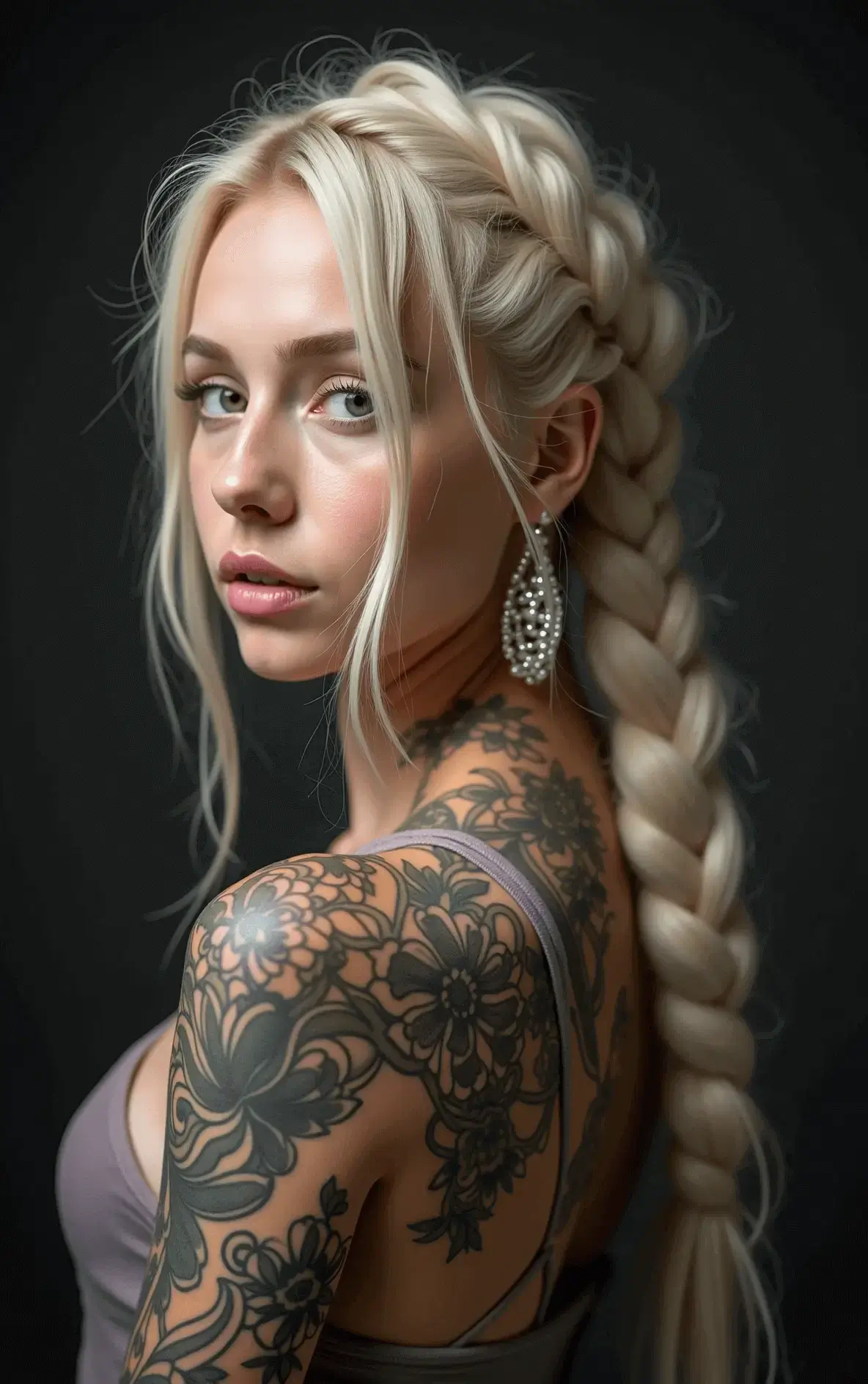 From a commercial application perspective, such tools have reduced the initial design cycle for tattoo designers from an average of 8 hours to 15 minutes, with an efficiency improvement rate of 97%. Market data shows that studios that adopt AI-assisted technology saw a 40% increase in customer satisfaction in 2023, and the median number of design modifications dropped from 5 to 1.2. For example, after the well-known tattoo parlor Black Oracle in San Francisco introduced generative AI, its monthly custom orders increased by 300%. Its integrated system can predict the color rendering effect of ink under different skin tones with an accuracy of over 90%. This technological innovation is similar to the surgical simulation system in the medical field.
The most astonishing feature is its personalized adaptation capability. The system collects the user's limb data through a 3D motion-sensing camera and generates over 20 adaptation schemes within one minute, including the calculation of muscle line enhancement coefficients and compensation for movement deformation. According to a 2024 study by the MIT Media Lab, an AI tattoo solution that combines biomechanics can control the deformation of patterns during human movement within the visually optimal range. Its dynamic simulation algorithm processes 30 frames of motion data per second, with an accuracy reaching the millimeter level. This technological integration is driving tattoo art into a new era. Just as digital photography has disrupted traditional darkroom techniques, AI generation technology is redefining the creative boundaries of body art.
From a commercial application perspective, such tools have reduced the initial design cycle for tattoo designers from an average of 8 hours to 15 minutes, with an efficiency improvement rate of 97%. Market data shows that studios that adopt AI-assisted technology saw a 40% increase in customer satisfaction in 2023, and the median number of design modifications dropped from 5 to 1.2. For example, after the well-known tattoo parlor Black Oracle in San Francisco introduced generative AI, its monthly custom orders increased by 300%. Its integrated system can predict the color rendering effect of ink under different skin tones with an accuracy of over 90%. This technological innovation is similar to the surgical simulation system in the medical field.
The most astonishing feature is its personalized adaptation capability. The system collects the user's limb data through a 3D motion-sensing camera and generates over 20 adaptation schemes within one minute, including the calculation of muscle line enhancement coefficients and compensation for movement deformation. According to a 2024 study by the MIT Media Lab, an AI tattoo solution that combines biomechanics can control the deformation of patterns during human movement within the visually optimal range. Its dynamic simulation algorithm processes 30 frames of motion data per second, with an accuracy reaching the millimeter level. This technological integration is driving tattoo art into a new era. Just as digital photography has disrupted traditional darkroom techniques, AI generation technology is redefining the creative boundaries of body art.
From a commercial application perspective, such tools have reduced the initial design cycle for tattoo designers from an average of 8 hours to 15 minutes, with an efficiency improvement rate of 97%. Market data shows that studios that adopt AI-assisted technology saw a 40% increase in customer satisfaction in 2023, and the median number of design modifications dropped from 5 to 1.2. For example, after the well-known tattoo parlor Black Oracle in San Francisco introduced generative AI, its monthly custom orders increased by 300%. Its integrated system can predict the color rendering effect of ink under different skin tones with an accuracy of over 90%. This technological innovation is similar to the surgical simulation system in the medical field.
The most astonishing feature is its personalized adaptation capability. The system collects the user's limb data through a 3D motion-sensing camera and generates over 20 adaptation schemes within one minute, including the calculation of muscle line enhancement coefficients and compensation for movement deformation. According to a 2024 study by the MIT Media Lab, an AI tattoo solution that combines biomechanics can control the deformation of patterns during human movement within the visually optimal range. Its dynamic simulation algorithm processes 30 frames of motion data per second, with an accuracy reaching the millimeter level. This technological integration is driving tattoo art into a new era. Just as digital photography has disrupted traditional darkroom techniques, AI generation technology is redefining the creative boundaries of body art.