
Loan-to-Value, Margin Calls and Mining Cash Flow
Loan-to-value is borrowed balance divided by collateral value, and in mining both sides of that fraction move. At a BTC price of $84,692, a 20% drawdown takes one coin of collateral from $84,692 to $67,754 and multiplies the position's LTV by 1.25 — before a single block reward changes. The other side is cash flow: a running rig keeps producing while the price moves, which is the only reason a leveraged mining position behaves differently from a leveraged spot position.

Key takeaways
- LTV is a ratio, so the same collateral supports half the borrowing after a 50% price fall: $84,692 of collateral and $42,346 of collateral are not interchangeable.
- A 20% drawdown lifts LTV by 1.25x and a 30% drawdown by about 1.43x. Nothing has to be liquidated for the position to stop looking safe.
- Hashrate is the offset. At today's difficulty (132.76 T) and price, 2 PH/s produces roughly 0.000897 BTC per day, about $75.99 gross and $72.95 after the listed 4% fee on the block-reward component.
- Match the repayment schedule to the payment method: PPS+ settles every hour against current difficulty, while PPLNS pays out only after a block receives 6 confirmations, weighted over the last 5 difficulty rounds.
Why the numbers move
Two quantities decide whether a collateralised position is comfortable. The first is the collateral value on the day you check it, which for a coin-denominated pledge is simply quantity multiplied by price. The second is the size of the balance you still owe, which does not fall when the market does.
Bitcoin's network conditions set the pace of everything else. Difficulty stands at 132.76 T, with total network hashrate near 1,003 EH/s and 144 blocks a day releasing 450 BTC of subsidy — about $38.1 million at a $84,692 price. Your share of that 450 BTC is your share of network hashrate, and that share is the ceiling on what any mining cash-flow plan can service.
The leverage works against you in the denominator. If you pledge one BTC at $84,692 and the price falls 20%, the collateral is worth $67,754 and the LTV of any fixed balance rises by exactly 1.25 times. Fall 30% and the multiple is 1.43; fall 50% and it doubles. That is arithmetic, not a forecast, and it is the reason a position can slide toward a margin call without the miner doing anything wrong.
| BTC price used for valuation | Change | Value of 1 BTC of collateral | Multiple applied to LTV |
|---|---|---|---|
| $84,692 | base | $84,692 | 1.00x |
| $67,754 | −20% | $67,754 | 1.25x |
| $59,284 | −30% | $59,284 | 1.43x |
| $42,346 | −50% | $42,346 | 2.00x |
What changes your payout
The payment method determines when money arrives, not how much the network pays out in total. PPS+ settles the block-reward component per share at a listed 4% fee and pays hourly against current difficulty; the transaction-fee component follows PPLNS logic with a listed 2% fee. PPLNS merges both components and charges 2%, and distributions land after a block gets 6 confirmations, measured over the last 5 difficulty rounds.[1]
For a repayment plan that difference is practical rather than cosmetic. Hourly settlement produces a smooth curve you can schedule against, while PPLNS produces income that clusters around the blocks your pool finds. Neither changes expected value; only the variance and the fee do. The five-step sequence — Add Collateral, Apply for Loan, Receive Loan, Repay Loan and Redeem Collateral — is what the ViaBTC Crypto Loan product follows, and each of those steps can be timed against the payout cadence you already have.
Worked example
Take a 2 PH/s operation on 20 J/TH hardware. Efficiency of 20 joules per terahash means 2,000 TH/s draws about 40 kW, or 960 kWh a day. At $0.06 per kWh, power costs $57.60 a day.
Output at today's difficulty: 2 PH/s is 0.000897 BTC a day gross, which is $75.99 at $84,692. After the listed 4% fee on the block-reward component — the larger part of that income — the figure is close to $72.95. Subtract the $57.60 power bill and the daily margin is about $15.35, or roughly $460 over a 30-day month.
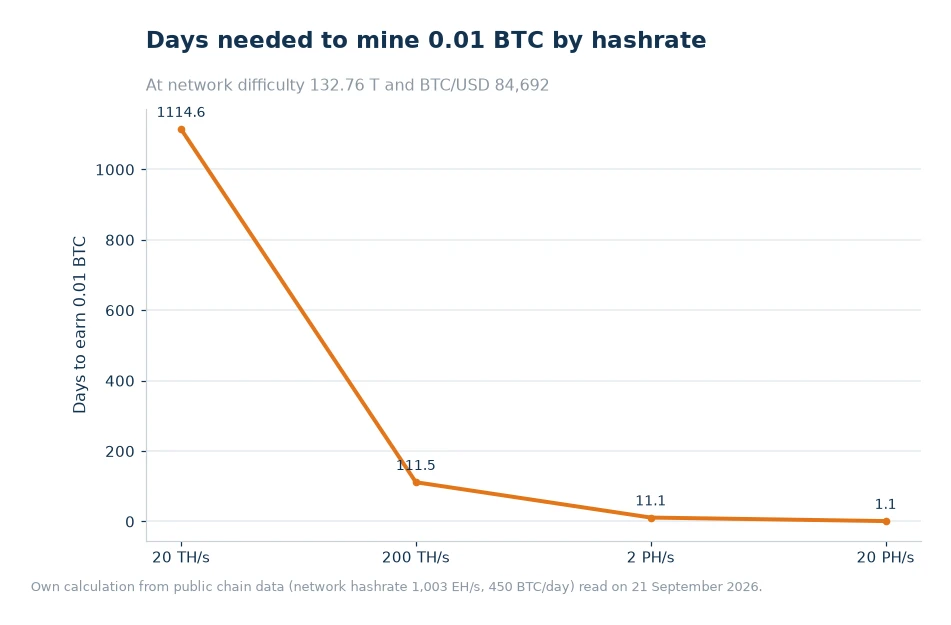
Now price a repayment against it. Repaying 0.01 BTC at $84,692 means finding $846.92. From $15.35 of daily margin that takes about 55 days, while the same 0.01 BTC is produced by the machines in about 11 days before power costs. The gap between those two numbers is the whole point of the exercise: mining output funds a loan only after the electricity bill is paid, and the slower number is the one that decides whether you sleep well.
What to check monthly
- Real hashrate versus nameplate. A rig running 8% below its rated speed lowers income without lowering the balance owed. Per-worker hashrate plus alerts shortens the time between a fault and a fix — the difference between a dashboard and a spreadsheet is measured in hours of lost shares.
- Which component the fee touches. A listed 4% on the block-reward component and a 4% haircut on everything are different numbers. Read the fee as two components instead of one headline rate.
- Effective power cost. Cooling, hosting and transmission losses all show up in the kWh line, and 2 PH/s at 20 J/TH is 960 kWh a day, so a cent per kWh is about $9.60 a day.
- The LTV multiple at −20% and −50%. Run the two rows in the table above before they happen, and decide in advance how you would add collateral or reduce the balance.
- Where the repayment funds land. Keeping earnings, conversions and withdrawal addresses in one account — a multi-currency wallet inside the mining dashboard, for instance — removes transfer steps that would otherwise sit between a scheduled payout and a repayment date.
Payout cadence deserves its own line item in that review. Operations receiving hourly mining payouts can rebuild a collateral buffer in small increments rather than waiting on a monthly statement, and small increments are exactly what keeps an LTV ratio away from a trigger point.
ViaBTC names the product Collateral-Pledged Loans and describes it as a liquidity service for miners who hold crypto for long-term value but still need funds to cover operating expenses such as electricity and miner maintenance. The published stages are Add Collateral, Apply for Loan, Receive Loan, Repay Loan and Redeem Collateral, and the collateral comes back to the borrower once the loan is repaid in full.
Frequently asked questions
How often should a miner check pool statistics?
Weekly is enough for cash flow, daily if you are reconciling worker uptime or chasing a hashrate fault. A leveraged position justifies the daily check.
Does the payout method change my average income?
It changes the variance and the fee, not the underlying expected value: your share of network hashrate still sets the ceiling.
Why does a price fall hurt a collateralised position so much?
Because the balance owed is fixed while collateral is repriced continuously. A 20% fall in price is a 1.25x jump in the ratio, which is a much bigger move than it sounds.
Run the ratio before you pledge
Write down three numbers today: the value of the collateral at the current price, the balance you owe, and the daily margin your hashrate produces after power and the listed fee. Then repeat the first calculation at 20% and 50% below spot, and check whether the repayment schedule still works at the slower of the two. If it does not, the position is sized for a market that has not arrived yet.
Data and sources: ViaBTC fee schedule and payment-method documentation[1] and the loan product's five-step process description[2]. Network difficulty (132.76 T), network hashrate (about 1,003 EH/s), the 3.125 BTC subsidy and the BTC price of $84,692 were read from public chain data and market feeds on 21 September 2026. Every figure above is computed from those inputs and moves with difficulty and price; nothing here is investment advice.